FOR HR AND SENIOR LEADERS
Spot burnout
before it costs you your strongest people
Under sustained pressure, the first people to break are usually the ones holding the most together. It shows up as lost momentum and quiet departures long before it shows up in the accounts. I help organisations catch it early and build resilience that holds performance under pressure.
ORGANISATIONS I HAVE WORKED WITH

“An outstanding and impactful keynote.”
HEAD OF HR
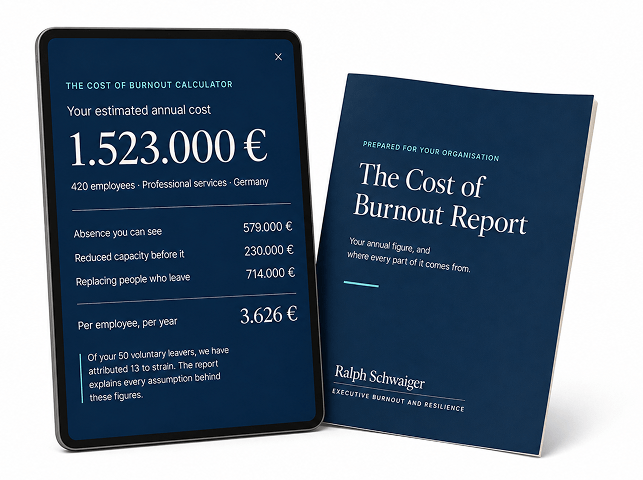
What is burnout actually costing you right now?
You are already paying for it either way. Most organisations have simply never put a figure on it, because the visible part is small and easy to absorb. A few sick days here, a long absence there, a resignation that gets explained some other way.
Answer a few questions about your organisation and you will get a defensible annual figure, along with a report showing where it comes from:
• the absence you can see,
• the months of reduced capacity before it,
• the cost of replacing people who leave,
• and the strain on everyone who absorbs the extra work.
It takes a couple of minutes. The report is yours to keep, and to forward to whoever controls the budget.
When I run this with HR directors, the total is usually several times what they had in mind.
You have probably seen this coming for a while
Maybe it was the survey. The stress and workload scores came back worse than anyone expected, and now the results are sitting on your desk along with the expectation that you do something about them.
Or maybe it arrived more quietly. Absence figures creeping up quarter after quarter. A senior person signed off long term. Someone capable handing in their notice with a reason that did not quite add up.
Your managers can see it too. They watch someone slowly stop being themselves, and they have no idea what they are supposed to do about it, so they work around it and hope it settles.
And the more senior the person, the less likely they are to say anything.
Admitting it feels like putting a spotlight on your own weakness.
The easy explanation is that a few people are having a hard year. I have rarely found that to be true. The pressure that wore them down has not gone anywhere, and it will do the same to the next person.
Most of what it costs never reaches your absence figures
The days someone is signed off are the part you can see, and they are the smaller part.
Long before anyone stops coming in, they spend months at their desk running on empty. Present, exhausted, producing a fraction of what they normally would. This costs more than the absence that follows it, and it appears in no report that reaches you.
You also carry more of the absence than you might think. In Germany, employers pay full salary for the first six weeks. Most burnout absences end before that, so the cost never passes to the insurer at all.
Then there is what happens around them. Their work moves to the people already carrying the most, the ones you can least afford to lose. Some of them quietly start looking elsewhere, and replacing one can cost most of a year’s salary.
When I walk an HR director through this, the total is usually several times what they had in their head. And none of it is a problem you can solve one person at a time.
17,4 %
of all sick days in Germany come from psychological diagnoses
DAK PSYCHREPORT
33 days
the average mental health absence, against 42 days of employer-paid sick leave
ENTGELTFORTZAHLUNGSGESETZ
75 to 150 %
of annual salary to replace someone who leaves
GALLUP AND SHRM

Why the last thing you tried
did not hold
If you have run something before and watched it fade, that was not a lack of commitment from anyone. The wellbeing week, the app, the workshop people genuinely enjoyed. Morale lifts for a week or two, then the same pressure produces the same result.
The problem is where those things sit.
Wellbeing is something a company offers. It runs alongside the work, it belongs to HR, and it asks people to opt in with time they do not have. Nothing about how the organisation operates changes, so nothing actually changes.
Pressure is fine. Performance is fine. The question is how we respond to it.
That is a skill, and skills can be trained. Resilience behaves like a muscle: train it, and it holds under load. Which makes it a capability, and capabilities get built and managed the same way you already manage performance or quality.
Which moves it into the hands of your managers.
They learn to recognise the early signs in their own teams before a sick note arrives, and they leave with a plan for their people rather than a set of principles. The tools themselves are small enough to use in the middle of a working day.
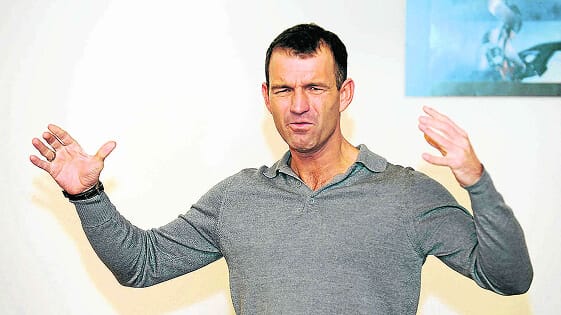
My first corporate keynote, 2008.
I learned this the hard way in 2006, and I have spent the twenty years since building what I wish someone had handed me then.
How this usually starts
Most organisations begin with a keynote.

01
Keynote
WHOLE WORKFORCE · ONLINE OR IN THE ROOM · SINGLE SESSION
It runs for the whole workforce, online or in the room. I tell them what happened to me, take apart the myths that keep burnout hidden, and give them tools small enough to use at a desk in sixty seconds. What it really does is make the subject speakable, which for most companies is the thing that has been missing.
Some stop there. Many do not, because once people are talking, your managers are the ones who need somewhere to put it.

02
Workshop
LEADERSHIP TEAM · HALF OR FULL DAY
That is the workshop. Your leadership team learns to recognise the early signs inside their own teams, and each leader leaves with a resilience roadmap for their own people rather than a set of principles.
03
One to one coaching
INDIVIDUALS · ONGOING ENGAGEMENT
And for the individuals under the most pressure, the ones you cannot afford to lose, there is one to one coaching.
Which of these you need, and in what order, depends entirely on where your organisation is. That is what the call is for.
Organisations that have brought this to their people
“The interest was enormous. With more than 100 guests, the hall was fully packed. We must lift the stigma surrounding burnout. It is essential to put a stop to poor working conditions and restore a healthy balance to our work.”
BOARD MEMBER FOR OCCUPATIONAL HEALTH AND SAFETY
FROM ORGANISATIONS
“An outstanding and impactful keynote.”
HEAD OF HR
“This topic is so important to me that I will give it significantly more consideration in my daily work in the future.”
KEYNOTE PARTICIPANT
FROM COACHING CLIENTS
"Initially, I was sceptical about coaching in general, but after experiencing intense stress over the past few months, I decided to give it a try and I'm really glad I did. He's empathetic yet direct and is always focused on finding practical solutions. His attitude is, you've got a problem? Let's solve it."
COACHING CLIENT
"Ralph has an exceptional talent for noticing what others might overlook. He not only pinpoints the core issues but also communicates them clearly and calmly, making complex situations feel simple."
COACHING CLIENT
Twenty years of international business leadership across Europe, Australia, and New Zealand, including senior roles at BASF and Douglas, and advisory work with New Zealand Trade and Enterprise. Certified trainer and coach through the BDVT. Currently lecturing on corporate resilience at the Wirtschaftsakademie Schleswig-Holstein.
AS FEATURED IN



I have been on the other side of this
I am Ralph Schwaiger, and in 2006 I was an export manager responsible for Eastern European markets. I had not slept properly in months, and one morning at four o’clock I got up and started emptying the dishwasher.
I could not decide whether to pick up the fork or the spoon first.
I stood there, a man who negotiated across national markets for a living, genuinely unable to choose between two pieces of cutlery. That was the morning I stopped being able to pretend I was simply tired.
By then I could not follow a straightforward conversation. I had withdrawn from the people closest to me. Not long after, I checked into a clinic.
What I heard from the people around me was not sympathy.
Inside, I met policemen, athletes, chief executives, doctors, teachers. All of them dealing with what I was dealing with. Break your leg and nobody questions the injury. When the damage is mental it stays invisible, so it stays hidden, and the shame finishes the job.
Pressure was never my problem. Not understanding how I responded to it was, and nobody had ever taught me the difference.
I spent the years after that learning it properly, qualified as a trainer and coach, and rebuilt my working life around energy rather than hours. Now I do that work with organisations, because I would far rather help a company prevent this than help someone recover from it.
Your people will not tell you they are at this point. I know, because I never told anyone either.
This is not for every organisation
I would rather tell you now than on the call.
THIS WORKS WHEN
You have a real problem, not a hypothetical one. Absence is climbing, a survey came back badly, someone senior has already gone off, or the pressure in your organisation has clearly stopped being sustainable.
Someone is prepared to act on it. There is a budget for people development and enough authority to spend it.
Your leaders are willing to be involved. The workshop asks something of them, and it does not work if they treat it as an HR exercise.
You want something that holds. If the goal is to be able to say you did something, there are cheaper ways to do that.
THIS DOES NOT WORK WHEN
You need a one-off event to tick a box. I will do a good keynote, but nothing will change afterwards, and we will both know it.
There is no willingness to look at the conditions themselves. I am not asking you to fix everything, but resilience training layered on top of an environment nobody is prepared to examine is unfair to the people in it.
You are looking for clinical treatment. I am not a therapist, and anyone in crisis needs proper medical support rather than a workshop.
Nobody above you thinks this matters. Without that, the work stalls after the first session.
Common questions
If something is not here, ask me on the call.
Fifteen minutes. You tell me what is going on in your organisation, and I tell you honestly whether I can help and how. If a keynote is not the right starting point, I will say so. There is no presentation and no pressure.
This is the question I am asked most. What changes it is that I am not talking to them as an outside expert on wellbeing. I ran international teams for twenty years and burned out doing it, and senior people listen differently to someone who has been where they are.
Mostly companies from around a hundred employees upward, across the DACH region and internationally. Recent work has ranged from a global food business to public administration and industrial organisations.
The keynote is a single session, online or in person. The workshop takes a full day with your leadership team. The tools themselves are designed for sixty seconds at a desk, because anything longer does not survive a real working day.
Yes. I work in both German and English, and I hold a teaching qualification for delivering professional training in English.If something is not here, ask me on the call.
It depends on which parts you need. The keynote is the smallest commitment and the usual starting point. The workshop is a step up from there, and coaching is priced per engagement. Most organisations start with the keynote and decide about the rest afterwards. I will give you real numbers on the call once I understand what you are dealing with.
Someone in your organisation is closer to burning out than you think
They are still turning up, still delivering, still telling everyone they are fine. That is exactly how it looked when it happened to me.
Fifteen minutes is enough for me to understand your situation and tell you honestly whether I can help, and where I would start.

Executive burnout and resilience
© 2026 Ralph Schwaiger
FIRST NAME
WORK EMAIL
ORGANISATION (optional)
Your headline figure appears on the next page, along with a short video where I explain what the number actually means. The full report arrives by email within a minute.